
ODM Fragrance Development: Where Your Budget Actually Goes
An ODM fragrance project costs more than the unit price, and the difference is usually larger than brands expect. The development fee, the exclusivity premium, the mould and the compliance pack each behave differently across the life of the range, and each can be negotiated once you can see it as its own line. This breakdown shows where an ODM budget really goes, so a procurement team can compare two manufacturers on structure rather than on price alone.
Key takeaways
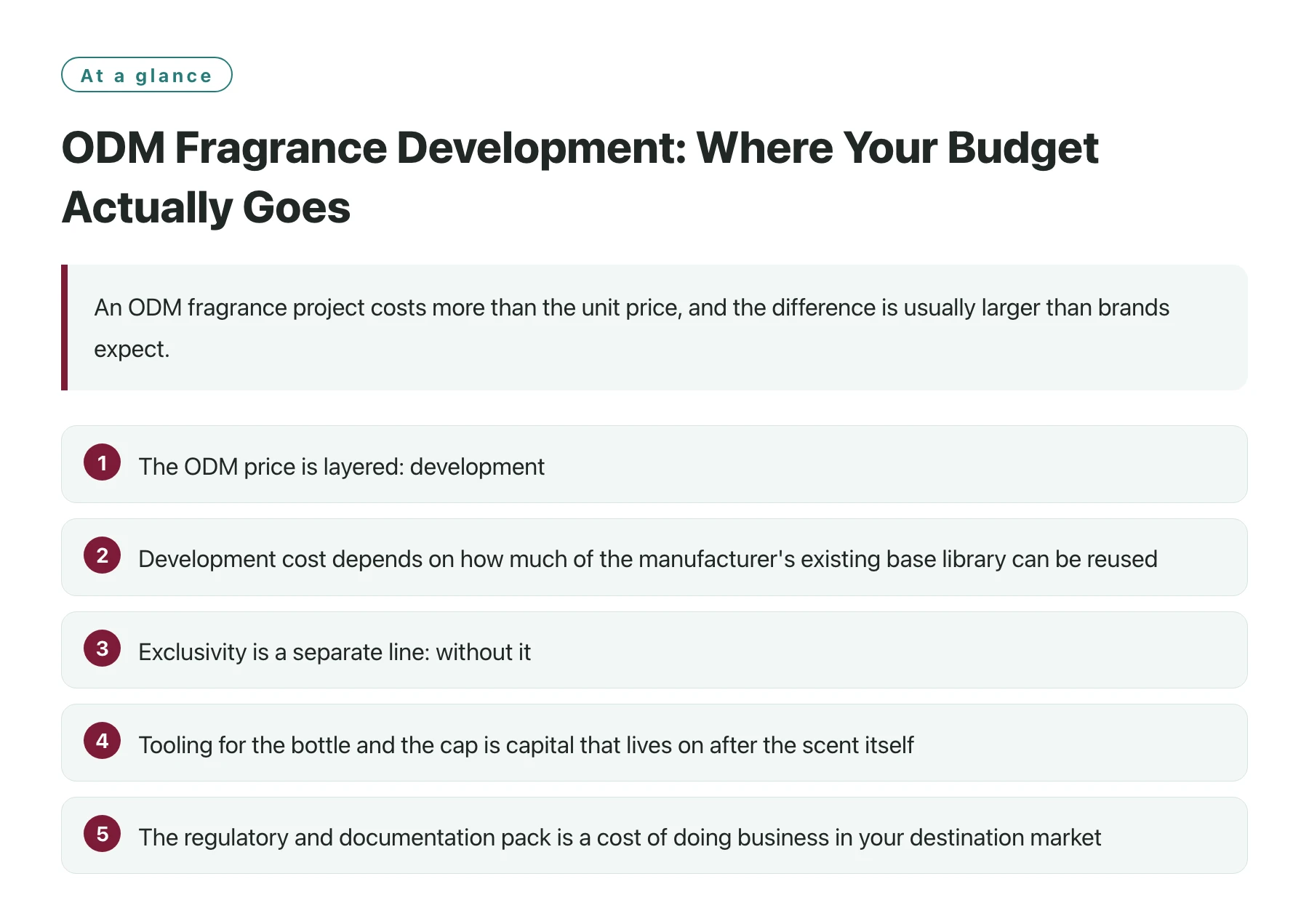
- The ODM price is layered: development, tooling, unit cost and compliance appear at different moments, and brands that compare only unit prices get quoted different structures.
- Development cost depends on how much of the manufacturer's existing base library can be reused, which is why the brief's clarity changes the invoice.
- Exclusivity is a separate line: without it, the base you adopt may be offered to competitors in the same market or category.
- Tooling for the bottle and the cap is capital that lives on after the scent itself; plan for how it amortises and who owns it at the end.
- The regulatory and documentation pack is a cost of doing business in your destination market, and the EU cosmetics framework makes that expectation explicit for the products it regulates [2].
Why ODM quotes are hard to compare
Two ODM manufacturers can quote the same brief and produce numbers that look wildly different, yet both be honest. One prices development explicitly and then quotes a lean unit cost; the other buries development in the unit price and looks expensive at volume. Neither is wrong until you know which structure you are looking at, and the first step of a cost breakdown is forcing the quote into the same five lines.
Once the structure is visible, the negotiation stops being about the number and starts being about the assumptions: how many revisions the price includes, how the base is reused, and what happens to the tooling if the range shrinks. A manufacturer that does its own development under one roof, the way an ODM fragrance manufacturer normally describes its service, can usually answer those questions from its own records rather than from a sales script.
The five lines every quote should expose
Request the quote split into development, revisions, tooling, unit cost and compliance. If a manufacturer cannot or will not split it, treat that as information: you are looking at a pricing model built to hide where the money goes.
Where the base library changes the maths
ODM development reuses existing accords and formats, and that reuse is what makes it cheaper than OEM for early-stage projects. The less of your brief the library already covers, the more the project behaves like custom development, so a realistic budget should price the gap between the library and the brief, not the library itself.
The ODM cost structure, line by line
| Line | What it pays for | Where it bites |
|---|---|---|
| Development fee | Perfumer time, base selection, initial samples | Appears once, but the number of revisions included is the real clause |
| Revision charges | Changes after the first approved sample | The most common hidden cost; fix the included round count in writing |
| Exclusivity premium | Keeping the adopted base out of competitors' hands | Forgettable at the sample stage, decisive in market positioning |
| Tooling | Bottle, cap, decoration plates and moulds | Capital that outlives the first order and needs an ownership clause |
| Unit cost | Compound, container, filling, packing per unit | Only comparable once the other four lines are visible |
| Compliance pack | IFRA statement, batch records, stability and market documents | Recurring with every batch, not a one-time project cost |
Read the first and second rows together. Most budget blowouts in ODM projects are revision blowouts: the development fee is set, the sample is almost right, and every round of almost adds a charge that was never written down.
The three clauses that change the total
First, the revision allowance. Settle how many rounds of development samples the fee covers, and what one extra round costs, before the first brief goes out. Second, exclusivity. If the scent is going to be the brand's signature, pay for exclusivity as an explicit line and confirm the scope, such as the market or the category, not just the word exclusive. Third, tooling ownership. The mould is a physical asset with a resale value, and the contract should say who owns it, who stores it and what happens when the range ends.
Bottle shapes and caps are industrial designs, and like the formula they can be registered through the international system administered by WIPO, which only helps the brand if the registration is held by the brand rather than the supplier [1]. None of these clauses adds drama; they add predictability. A brand that runs the same three questions against two suppliers will often find the cheaper unit price has paid for itself in revision charges by the second season.
The pilot order as a cost audit
The first ODM order is also the first accurate cost audit, because it is the only moment when development, tooling, production and compliance appear in one invoice. Compare that invoice against the structure you agreed, and treat every divergence as a renegotiation point, not a bookkeeping surprise.
A useful mental model: ODM buys you speed and a lower entry cost, and it does that by reusing what the manufacturer already knows. The whole craft of the budget is pricing exactly how much of that reuse your brief qualifies for, and writing down every charge that appears when the answer is less reuse than hoped.
Keeping the next range cheaper than the first
The second ODM project should cost less than the first, for a reason that has nothing to do with negotiation: the brand now owns references, an approved base, a launch dossier and a relationship. Those are assets that reduce development time, and the budget should reflect it.
That is also the moment to compare unit costs against market signals. A well-documented quotation from a manufacturer that publishes its capabilities, such as the one behind this article's guide to how to compare perfume quotes, gives a procurement team a stable yardstick for the next three ranges.
Sources
- WIPO — World Intellectual Property Organization —— The UN agency for intellectual property; resources on industrial design and patent protection relevant to product and packaging design.
- European Commission: Cosmetics in the EU —— The European Commission's overview of EU cosmetics rules, including the responsible person, product information file and safety report requirements.
Frequently asked questions
Why is the development fee different between ODM suppliers?
Because the fee reflects how much of the supplier's existing base library your brief can reuse. A brief close to the supplier's library is cheaper to develop; a brief that needs new accords behaves more like custom development. Ask each supplier what in the library matches your brief before comparing fees.
Should we pay for exclusivity on the first project?
Only if the scent is central to the brand's positioning. Exclusivity is priced per market or category, so an early-stage brand can often defer it, but the contract should already state the price and scope, because retroactive exclusivity is expensive to negotiate.
What is the difference between tooling cost and unit cost?
Tooling is the one-time capital for moulds, caps and decoration plates; unit cost is the recurring cost per filled and packed product. Tooling amortises across the total volume, which is why a large first order makes an expensive mould look cheap and a small one makes it look ruinous.
How many revision rounds should a development fee include?
Three is a common and defensible allowance for an ODM project, because the first round finds the direction and later rounds refine it. Whatever the count, it must be written down, along with the cost of an extra round, before the fee is agreed.
Where do compliance costs appear in an ODM quote?
Sometimes inside the unit cost, sometimes as a separate project line, and sometimes as a surprise on the first invoice. Ask explicitly for the compliance pack as its own line, and confirm what it covers per market, because destination-market rules are where undocumented costs hide.