
Five Thousandths of a Coin as a Purchase Test
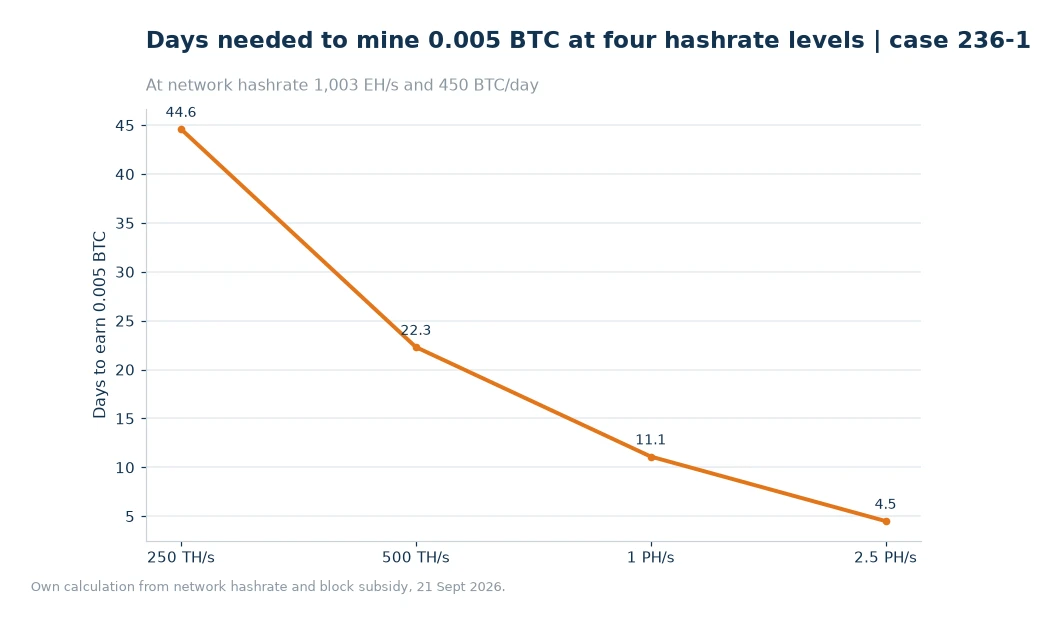
0.005 BTC is a small enough target to reach in weeks and large enough to expose a weak setup. At 250 TH/s it takes 44.6 days; at 2.5 PH/s it takes 4.5. That spread works better as a shopping filter than a spec sheet's peak hashrate, because it folds price, watts and time into one line you can compare.
Key takeaways
- At 250 TH/s, 0.005 BTC takes 44.6 days; at 2.5 PH/s, the same target takes 4.5 days.
- 0.005 BTC is $423.46 at $84,692, which gives the target a cash value to set against the hardware price.
- Pool Hashrate moves the finish line for every buyer at once, so a machine bought today is priced against tomorrow's total.
- A slower unit that draws less power can still be the better purchase once the surplus is counted.
A target small enough to test, large enough to matter
Most hardware comparisons drown in columns: joules per terahash, firmware versions, fan diameters, warranty length. All of them matter and none of them answers the buyer's real question, which is how long the machine has to run before it has produced something worth having. A fixed coin target turns that question into a single number.
Five thousandths of a bitcoin is a good size for the test. It is far enough away that a machine's efficiency shows up in the result, and close enough that the answer arrives within a season rather than a decade. At $84,692 per BTC it is worth $423.46, so the target also has a price you can hold next to the invoice.
It also has a property that larger targets lack: it can be missed without being fatal. A buyer who plans for 0.005 BTC and receives it three weeks late has lost time, not capital. That makes the target a low-stakes way to learn how a machine behaves in your own room before committing to a bigger order.
Turning the target into a waiting time
The conversion needs one constant. With 450 BTC issued a day across about 1,003 EH/s, each terahash earns 0.00000044865 BTC daily. Divide the target by that and by your hashrate. A 250 TH/s unit produces 0.00011216 BTC a day, so 0.005 BTC arrives after 44.6 days of uninterrupted work.
Uninterrupted is doing real work in that sentence. A firmware update, a failed fan, a thunderstorm or a family holiday can each cost hours or days, and the calendar does not pause while they happen. Add a realistic allowance before comparing the result with a seller's claim, which is usually computed on a machine that never sleeps.
What Pool Hashrate adds to a spec sheet
The ViaBTC Pool Hashrate number is not a property of the machine you are buying, and that is exactly why it belongs in the comparison. It tells you the size of the pool whose blocks you will share in, and the neighbouring network total tells you the size of the race. A spec sheet is silent on both.
Read them as context rather than as a forecast. A network total that has been climbing for months will make every waiting time on this page longer by the time your unit is plugged in. A pool total that is shrinking might mean miners are leaving, which is worth understanding before you join. Neither number tells you the price of the machine, but both tell you what the machine's output will be divided by.
Pool Luck and the spread around the average
Pool Luck is the gap between blocks found and blocks expected. It is the reason two miners with identical hardware can report different short-run results, and it is the reason a PPLNS balance arrives in steps while a PPS+ balance arrives in a smooth line. Neither miner is doing anything wrong. They are reading different statistics.
For a purchase decision, luck is a reason to hold a buffer, not a reason to prefer one brand. A machine that reaches 0.005 BTC in 44.6 days on average may take 50 in an unlucky stretch. If your plan cannot absorb six extra days, the plan is too tight for mining at this scale, and no hardware choice will make it robust.
Four sizes on one grid
The grid prices the same target across four sizes, from a single mid-size unit to a small cluster. The dollar column uses $84,692 per BTC and is gross of power.
| Class | Hashrate | BTC per day | Days to 0.005 BTC | Gross USD per day |
|---|---|---|---|---|
| Single unit | 250 TH/s | 0.00011216 | 44.6 | $9.50 |
| Two units | 500 TH/s | 0.00022433 | 22.3 | $19.00 |
| Small rack | 1 PH/s | 0.00044865 | 11.1 | $37.99 |
| Cluster | 2.5 PH/s | 0.00112163 | 4.5 | $94.98 |
The speed column improves tenfold from top to bottom, and the money column improves tenfold with it. What does not appear is the power column, which also rises roughly tenfold. That is the trap in reading only the first four columns: the fastest row is not automatically the most profitable one, it is only the one that finishes first.
Price, watts and the wait
Three quantities decide a purchase. The invoice price is the obvious one. The watts at the wall decide the running cost, and the wait decides how long you carry both before the target is met. A used unit at half the price of a new one but with 30% worse efficiency can lose the comparison in a year of running, even though it wins on day one.
Put them on one line: price plus watts times hours times tariff, divided by the coins produced. The result is a cost per bitcoin that can be compared across machines of different sizes. It is not a forecast of price and it is not advice; it is the only arithmetic that puts a cheap machine and an efficient machine on the same page.
Worked example
Take the 250 TH/s row and the cluster row through the same steps.
- Start with the network: 450 BTC ÷ 1,003,000,000 TH/s = 0.00000044865 BTC per TH/s.
- 250 TH/s: 250 × 0.00000044865 = 0.00011216 BTC a day.
- Days to 0.005 BTC: 0.005 ÷ 0.00011216 = 44.58, rounded to 44.6.
- Gross value: 0.00011216 × 84,692 = $9.50 a day, and the target is worth $423.46.
- 2.5 PH/s is 2,500 TH/s: 2,500 × 0.00000044865 = 0.00112163 BTC a day.
- Days to 0.005 BTC at that size: 0.005 ÷ 0.00112163 = 4.46, rounded to 4.5.
Frequently asked questions
How long does 0.005 BTC take at 250 TH/s?
44.6 days, since 250 TH/s credits 0.00011216 BTC a day and 0.005 ÷ 0.00011216 = 44.6.
Is a bigger machine always the better route to 0.005 BTC?
It is faster, not automatically better. The 2.5 PH/s case finishes in 4.5 days but draws roughly ten times the power of the 250 TH/s unit, so the surplus after electricity can be thinner than the speed suggests.
Where does Pool Luck fit a purchase decision?
It affects the variance of what the pool finds, not the size of a PPS+ credit. Treat it as a reason to keep a buffer in the plan rather than a reason to choose one machine over another.
Buy the wait you can actually afford
Write the target, the days and the power cost in one row for each candidate. The machine that wins is the one whose surplus after electricity still looks acceptable when the wait is 10% longer than the estimate. If no row survives that test, the right purchase is no purchase, and the target can wait for better conditions.
The Miner Profitability Ranking gives a current view of models against conditions, and the pricing page sets out the listed settlement rates. Use both as inputs to the row, not as a verdict on it.
Sources: ViaBTC pool state, miner ranking and pricing pages; chain inputs read 21 Sept 2026: network hashrate 1,003 EH/s, difficulty 132.76 T, subsidy 3.125 BTC per block, 144 blocks a day, BTC $84,692. Waiting times assume continuous operation at current difficulty. Figures read 21 Sept 2026, published 24 Oct 2026[1].