
Why is urethane casting effective for low-volume production?
In terms of the efficiency of initial investment, urethane casting shows significant advantages. The cost of making a silicone mold suitable for small-batch production is usually between 200 and 1,500 US dollars, and it only takes 1 to 3 days. In contrast, the investment in traditional steel injection molds is usually over 10,000 US dollars, and the development cycle lasts for 6 to 12 weeks. For orders ranging from 50 to 500 pieces, the unit part cost of polyurethane casting is on average 65% lower than that of injection molding. Data provided by contract manufacturer Proto Labs shows that the average quote for its polyurethane casting service is 75% lower than the cost of small-batch injection molding, and the delivery time is shortened by approximately 85%, making it the preferred choice for small-batch prototyping and trial production (especially for parts with dimensions ranging from 500 grams to 5 kilograms and tolerance requirements of ± 0.13mm).
The flexibility of the production process is another core advantage. The polyurethane casting process does not require expensive high-pressure equipment. The operating pressure is as low as 0.2 MPa - 0.5 MPa, which is much lower than the 35 MPa - 140 MPa required for injection molding. This enables the simultaneous casting of products of various materials (such as different specifications of Shore A hardness ranging from 20A to 85D) and color systems in the same batch, with only about 10% of the debugging time required for each replacement. When developing the new lamp assembly, Trek Bicycle Company used this technology to complete the production of five different hardness seals (dimensional tolerance ± 0.15mm) and three colors of shells within 72 hours, while the traditional method requires three times the verification period.
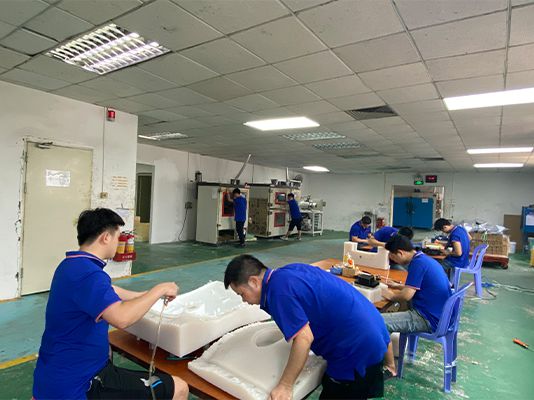 urethane casting can highly realistically replicate the appearance and physical properties of products. The surface roughness of the cast part can be controlled below Ra 0.8 μm, and the precision is close to the injection molding standard. The proportion of casting materials that have passed ISO 10993 biocompatibility certification can reach 85%, and the proportion of UL94 V-0 flame retardant grade formulas is approximately 60%. In 2022, NASA used polyurethane casting technology in its Mars environment simulation project to produce 37 sets of instrument housing simulation parts that needed to undergo harsh temperature cycles ranging from -120°C to 80°C (more than 500 times). The physical performance test error was controlled within ±5% of the standard value. Verify the applicability of this process to high-demand functional components.
Polyurethane casting has obvious advantages in terms of resource utilization and supply chain agility. Its material utilization rate usually exceeds 97%, which is much higher than the average 85% level of injection molding. For the development stage that requires iterative design, modifying silicone molds takes an average of only 1 to 2 days and costs 15% to 30% of the initial investment, while modifying steel molds may consume 40% to 70% of the total project budget. When developing educational robots, consumer electronics company Sphero carried out 23 design iterations through polyurethane casting within a six-month test period. The mold-related costs accounted for only 8% of the total development expenses. Meanwhile, the lightweight components (with a density of 1.1-1.3g /cm³) were reduced by approximately 20% compared to injection molded parts. Priority choices that meet Apple's requirements for reducing carbon emissions from third-party accessories. urethane casting effectively shortened the time to market by 60% while reducing the risk of small-batch inventory.
urethane casting can highly realistically replicate the appearance and physical properties of products. The surface roughness of the cast part can be controlled below Ra 0.8 μm, and the precision is close to the injection molding standard. The proportion of casting materials that have passed ISO 10993 biocompatibility certification can reach 85%, and the proportion of UL94 V-0 flame retardant grade formulas is approximately 60%. In 2022, NASA used polyurethane casting technology in its Mars environment simulation project to produce 37 sets of instrument housing simulation parts that needed to undergo harsh temperature cycles ranging from -120°C to 80°C (more than 500 times). The physical performance test error was controlled within ±5% of the standard value. Verify the applicability of this process to high-demand functional components.
Polyurethane casting has obvious advantages in terms of resource utilization and supply chain agility. Its material utilization rate usually exceeds 97%, which is much higher than the average 85% level of injection molding. For the development stage that requires iterative design, modifying silicone molds takes an average of only 1 to 2 days and costs 15% to 30% of the initial investment, while modifying steel molds may consume 40% to 70% of the total project budget. When developing educational robots, consumer electronics company Sphero carried out 23 design iterations through polyurethane casting within a six-month test period. The mold-related costs accounted for only 8% of the total development expenses. Meanwhile, the lightweight components (with a density of 1.1-1.3g /cm³) were reduced by approximately 20% compared to injection molded parts. Priority choices that meet Apple's requirements for reducing carbon emissions from third-party accessories. urethane casting effectively shortened the time to market by 60% while reducing the risk of small-batch inventory.
urethane casting can highly realistically replicate the appearance and physical properties of products. The surface roughness of the cast part can be controlled below Ra 0.8 μm, and the precision is close to the injection molding standard. The proportion of casting materials that have passed ISO 10993 biocompatibility certification can reach 85%, and the proportion of UL94 V-0 flame retardant grade formulas is approximately 60%. In 2022, NASA used polyurethane casting technology in its Mars environment simulation project to produce 37 sets of instrument housing simulation parts that needed to undergo harsh temperature cycles ranging from -120°C to 80°C (more than 500 times). The physical performance test error was controlled within ±5% of the standard value. Verify the applicability of this process to high-demand functional components.
Polyurethane casting has obvious advantages in terms of resource utilization and supply chain agility. Its material utilization rate usually exceeds 97%, which is much higher than the average 85% level of injection molding. For the development stage that requires iterative design, modifying silicone molds takes an average of only 1 to 2 days and costs 15% to 30% of the initial investment, while modifying steel molds may consume 40% to 70% of the total project budget. When developing educational robots, consumer electronics company Sphero carried out 23 design iterations through polyurethane casting within a six-month test period. The mold-related costs accounted for only 8% of the total development expenses. Meanwhile, the lightweight components (with a density of 1.1-1.3g /cm³) were reduced by approximately 20% compared to injection molded parts. Priority choices that meet Apple's requirements for reducing carbon emissions from third-party accessories. urethane casting effectively shortened the time to market by 60% while reducing the risk of small-batch inventory.